Showing posts with label anklebiting. Show all posts

Monday, March 11, 2013

"Recession Is a Time of Harvest"

Noah and Seth say pretty much everything that needs to be said about this latest #Slatepitch provocation from Matt Yglesias.  [1] So, traa dy lioaur, I am going to say something that does not need to be said, but is possibly interesting.

Yglesias claims that "the left" is wrong to focus on efforts to increase workers' money incomes, because higher wages just mean higher prices. Real improvements in workers' living standards -- he says -- come from the same source as improvements for rich people, namely technological innovation. What matters is rising productivity, and a rise in productivity necessarily means a fall in (someone's) nominal income. So we need to forget about raising the incomes of particular people and trust the technological tide to lift all boats.

As Noah and Seth say, the logic here is broken in several places. Rising productivity in a particular sector can raise incomes in that sector as easily as reduce them. Changes in wages aren't always passed through to prices, they can also reflect changes in the distribution between wages and other income.

I agree, it's definitely wrong as a matter of principle to say that there's no link, or a negative link, between changes in nominal wages and changes in the real standard of living. But what kind of link is there, actually? What did our forebears think?

Keynes notoriously took the Yglesias line in the General Theory, arguing that real and nominal wages normally moved in opposite directions. He later retracted this view, the only major error he conceded in the GT (which makes it a bit unfortunate that it's also the book's first substantive claim.) Schumpeter made a similar argument in Business Cycles, suggesting that the most rapid "progress in the standard of life of the working classes" came in periods of deflation, like 1873-1897. Marx on the other hand generally assumed that the wage was set in real terms, so as a first approximation we should expect higher productivity in wage-good industries to lead to lower money wages, and leave workers' real standard of living unchanged. Productivity in this framework (and in post-GT Keynes) does set a ceiling on wages, but actual wages are almost well below this, with their level set by social norms and the relative power of workers and employers.

But back to Schumpeter and the earlier Keynes. It's worth taking a moment to think through why they thought there would be a negative relationship between nominal and real wages, to get a better understanding of when we might expect such a relationship.

For Keynes, the logic is simple. Wages are equal to marginal product. Output is produced in conditions of declining marginal returns. (Both of assumptions are wrong, as he conceded in the 1939 article.) So when employment is high, the real wage must be low. Nominal wages and prices generally move proportionately, however, rising in booms and falling in slumps. (This part is right.) So we should expect a move toward higher employment to be associated with rising nominal wages, even though real wages must fall. You still hear this exact argument from people like David Glasner.

Schumpeter's argument is more interesting. His starting point is that new investment is not generally financed out of savings, but by purchasing power newly created by banks. Innovations are almost never carried out by incumbent producers simply adopting the new process in place of the existing one, but rather by some new entrant -- the famous entrepreneur-- operating with borrowed funds. This means that the entrepreneur must bid away labor and other inputs from their current uses (importantly, Schumpeter assumes full employment) pushing up costs and prices. Furthermore, there will be some extended period of demand from the new entrants for labor and intermediate goods while the incumbents have not yet reduced theirs -- the initial period of investment in the new process (and various ancillary processes -- Schumpeter is thinking especially of major innovations like railroads, which will increase demand in a whole range of related industries), and later periods where the new entrants are producing but don't yet have a decisive cost advantage, and a further period where the incumbents are operating at a loss before they finally exit. So major innovations tend to involve extended periods of rising prices. It's only once the new producers have thoroughly displaced the old ones that demand and prices fall back to their old level. But it's also only then that the gains from the innovation are fully realized. As he puts it (page 148):
Times of innovation are times of effort and sacrifice, of work for the future, while the harvest comes after... ; and that the harvest is gathered under recessive symptoms and with more anxiety than rejoicing ... does not alter the principle. Recession [is] a time of harvesting the results of preceding innovation...
I don't think Schumpeter was wrong when he wrote. There is probably some truth to idea that falling prices and real wages went together in 19th century. (Maybe by 1939, he was wrong.)

I'm interested in Schumpeter's story, though, as more than just intellectual history, fascinating tho that is. Todays consensus says that technology determines the long-term path of the economy, aggregate demand determines cyclical deviations from that path, and never the twain shall meet. But that's not the only possibility. We talked the other day about demand dynamics not as -- as in conventional theory -- deviations from the growth path in response to exogenous shocks, but as an endogenous process that may, or may not, occasionally converge to a long-term growth trajectory, which it also affects.

In those Harrod-type models, investment is simply required for higher output -- there's no innovation or autonomous investment booms. Those are where Schumpeter comes in. What I like about his vision is it makes it clear that periods of major innovation, major shifts from one production process to another, are associated with higher demand -- the major new plant and equipment they require, the reorganization of the spatial and social organization of production they entail ("new plant, new firms, new men," as he says) make large additional claims on society's resources. This is the opposite of the "great recalculation" claim we were hearing a couple years ago, about how high unemployment was a necessary accompaniment to major geographic or sectoral shifts in output; and also of the more sophisticated version of the recalculation argument that Joe Stiglitz has been developing. [2] Schumpeter is right, I think, when he explicitly says that if we really were dealing with "recalculation" by a socialist planner, then yes, we might see labor and resources withdrawn from the old industries first, and only then deployed to the new ones. But under capitalism things don't work like that  (page 110-111):
Since the central authority of the socialist state controls all existing means of production, all it has to do in case it decides to set up new production functions is simply to issue orders to those in charge of the productive functions to withdraw part of them from the employments in which they are engaged, and to apply the quantities so withdrawn to the new purposes envisaged. We may think of a kind of Gosplan as an illustration. In capitalist society the means of production required must also be ... [redirected] but, being privately owned, they must be bought in their respective markets. The issue to the entrepreneurs of new means of payments created ad hoc [by banks] is ... what corresponds in capitalist society to the order issued by the central bureau in the socialist state. 
In both cases, the carrying into effect of an innovation involves, not primarily an increase in existing factors of production, but the shifting of existing factors from old to new uses. There is, however, this difference between the two methods of shifting the factors : in the case of the socialist community the new order to those in charge of the factors cancels the old one. If innovation were financed by savings, the capitalist method would be analogous... But if innovation is financed by credit creation, the shifting of the factors is effected not by the withdrawal of funds—"canceling the old order"—from the old firms, but by ... newly created funds put at the disposal of entrepreneurs : the new "order to the factors" comes, as it were, on top of the old one, which is not thereby canceled.
This vision of banks as capitalist Gosplan, but with the limitation that they can only give orders for new production on top of existing production, seems right to me. It might have been written precisely as a rebuttal to the "recalculation" arguments, which explicitly imagined capitalist investment as being guided by a central planner. It's also a corrective to the story implied in the Slate piece, where one day there are people driving taxis and the next day there's a fleet of automated cars. [3] Before that can happen, there's a long period of research, investment, development -- engineers are getting paid, the technology is getting designed and tested and marketed, plants are being built and equipment installed -- before the first taxi driver loses a dollar of income. And even once the driverless cars come on line, many of the new companies will fail, and many of the old drivers will hold on for as long as their credit lasts. Both sets of loss-making enterprises have high expenditure relative to their income, which by definition boosts aggregate demand. In short, a period of major innovations must be a period of rising nominal incomes -- as we most recently saw, on a moderate scale, in the late 1990s.

Now for Schumpeter, this was symmetrical: High demand and rising prices in the boom were balanced by falling prices in the recession -- the "harvest" of the fruits of innovation. And it was in the recession that real wages rose. This was related to his assumption that the excess demand from the entrepreneurs mainly bid up the price of the fixed stock of factors of production, rather than activating un- or underused factors. Today, of course, deflation is extremely rare (and catastrophic), and output and employment vary more over the cycle than wages and prices do. And there is a basic asymmetry between the boom and the bust. New capital can be added very rapidly in growing enterprises, in principle; but gross investment in the declining incumbents cannot fall below zero. So aggregate investment will always be highest when there are large shifts taking place between sectors or processes. Add to this that new industries will take time to develop the corespective market structure that protects firms in capital-intensive industries from cutthroat competition, so they are more likely to see "excess" investment. And in a Keynesian world, the incomes from innovation-driven investment will also boost consumption, and investment in other sectors. So major innovations are likely to be associated with booms, with rising prices and real wages.

So, but: Why do we care what Schumpeter thought 75 years ago, especially if we think half of it no longer holds? Well, it's always interesting to see how much today's debates rehash the classics. More importantly, Schumpeter is one of the few economists to have focused on the relation of innovation, finance and aggregate demand (even if, like a good Wicksellian, he thought the latter was important only for the price level); so working through his arguments is a useful exercise if we want to think more systematically about this stuff ourselves. I realize that as a response to Matt Y.'s silly piece, this post is both too much and poorly aimed. But as I say, Seth and Noah have done what's needed there. I'm more interested in what relationship we think does hold, between innovation and growth, the price level, and wages.

As an economist, my objection to the Yglesias column (and to stuff like the Stiglitz paper, which it's a kind of bowdlerization of) is that the intuition that connects rising real incomes to falling nominal incomes is just wrong, for the reasons sketched out above. But shouldn't we also say something on behalf of "the left" about the substantive issue? OK, then: It's about distribution. You might say that the functional distribution is more or less stable in practice. But if that's true at all, it's only over the very long run, it certainly isn't in the short or medium run -- as Seth points out, the share of wages in the US is distinctly lower than it was 25 years ago. And even to the extent it is true, it's only because workers (and, yes, the left) insist that nominal wages rise. Yglesias here sounds a bit like the anti-environmentalists who argue that the fact that rivers are cleaner now than when the Clean Water Act was passed, shows it was never needed. More fundamentally, as a leftist, I don't agree with Yglesias that the only important thing about income is the basket of stuff it procures. There's overwhelming reason -- both first-principle and empirical -- to believe that in advanced countries, relative income, and the power, status and security it conveys, is vastly more important than absolute income. "Don't worry about conflicting interests or who wins or loses, just let the experts make things better for everyone": It's an uncharitable reading of the spirit behind this post, but is it an entirely wrong one?


UPDATE: On the other hand. In his essay on machine-breaking, Eric Hobsbawm observes that in 18th century England,
miners' riots were still directed against high food prices, and the profiteers believed to be responsible for them.
And of course more generally, there have been plenty of working-class protests and left political programs aimed at reducing the cost of living, as well as raising wages. Food riots are a major form of popular protest historically, subsidies for food and other necessities are a staple policy of newly independent states in the third world (and, I suspect, also disapproved by the gentlemen of Slate), and food prices are a preoccupation of plenty of smart people on the left. (Not to mention people like this guy.) So Yglesias's notion that "the left" ignores this stuff is stupid. But if we get past the polemics, there is an interesting question here, which is why mass politics based around people's common interests as workers is so much more widespread and effective than this kind of politics around the cost of living. Or, maybe better, why one kind of conflict is salient in some times and places and the other kind of conflict in others; and of course in some, both.


[1] Seth's piece in particular is a really masterful bit of polemic. He apologizes for responding to trollery, which, yeah, the Yglesias post arguably is. But if you must feed trolls, this is how it's done. I'm not sure if the metaphor requires filet mignon and black caviar, or dogshit garnished with cigarette butts, or fresh human babies, but whatever it is you should ideally feed a troll, Seth serves it up.

[2] It appears that Stiglitz's coauthor Bruce Greenwald came up with this first, and it was adopted by right-wing libertarians like Arnold Kling afterwards.

[3] I admit I'm rather skeptical about the prospects for driverless cars. Partly it's that the point is they can operate with much smaller error tolerances than existing cars -- "bumper to bumper at highway speeds" is the line you always hear -- but no matter how inherently reliable the technology, these things are going to be owned maintained by millions of individual nonprofessionals. Imagine a train where the passengers in each car were responsible for making sure it was securely coupled to the next one. Yeah, no. But I think there's an even more profound reason, connected to the kinds of risk we will and will not tolerate. I was talking to my friend E. about this a while back, and she said something interesting: "People will never accept it, because no one is responsible for an accident. Right now, if  there's a bad accident you can deal with it by figuring out who's at fault. But if there were no one you could blame, no one you could punish, if it were just something that happened -- no one would put up with that." I think that's right. I think that's one reason we're much more tolerant of car accidents than plane accidents, there's a sense that in a car accident at least one of the people involved must be morally responsible. Totally unrelated to this post, but it's a topic I'd like to return to at some point -- that what moral agency really means, is a social convention that we treat causal chains as being broken at certain points -- that in some contexts we treat people's actions as absolutely indeterminate. That there are some kinds of in principle predictable actions by other people that we act -- that we are morally obliged to act -- as if we cannot predict.

Wednesday, June 27, 2012

In Which I Dare to Correct Felix Salmon

Felix Salmon is my favorite business blogger -- super smart, cosmopolitan and impressively unimpressed by the Masters of the Universe he spends his days observing. In general, I'd expect him to be much more on top of current financial data than I am. But in today's post on the commercial paper market, he makes an uncharacteristic mistake -- or rather, uncharacteristic for him but highly characteristic of the larger conversation around finance.

According to Felix:
The commercial paper market has to a first approximation become an entirely financial market, a place for banks and shadow banks to do their short-term borrowing while the interbank market remains closed.
According to David S. Scharfstein of Harvard Business School, who also testified last week, of the 50 largest issuers of debt to money market funds today, only two are nonfinancial firms; the rest are banks and other financial companies, many of them foreign.
Once upon a time, before the financial crisis, money-market funds were a mechanism whereby individual investors could make safe, short-term loans to big corporates, disintermediating the banks. But all that has changed now. For one thing, says Davidoff, “about two-thirds of money market users are sophisticated finance investors”. For another, the corporates have evaporated away, to be replaced by financials. In the corporate world, it seems, the price mechanism isn’t working any more: either you’re a big and safe corporate and don’t want to run the refinancing risk of money-market funds suddenly drying up, or else you’re small enough and risky enough that the money market funds don’t want to lend to you at any price.
I'm sorry, but I don't think that's right.

Reading Felix, you get the clear impression that before the crisis, or anyway not too long ago, most borrowers in the commercial paper market were nonfinancial corporations. It has only "become an entirely financial market" relatively recently, he suggests, as nonfinancial borrowers have dropped out. But, to me at least, the real picture looks rather different.

Source: Flow of Funds

The graph shows outstanding financial and nonfinancial commercial paper on the left scale, and the financial share of the total on the right scale. As you can see the story is almost the opposite of the one Felix tells. Financial borrowers have always dominated the commercial paper market, and their share has fallen, not risen, in the wake of the financial crisis and recession. Relative to the economy, nonfinancial commercial paper outstanding is close to where it was at the peak of the past cycle. But financial paper is down by almost two-thirds. As a result, the nonfinancial share of the commercial paper market has doubled, from 7 to 15 percent -- the highest it's been since the 1990s.

Why does this matter? Well, of course, it's important to get these things right. But I think Felix's mistake here is revealing of a larger problem.

One of the most dramatic features of the financial crisis of fall 2008, bringing the Fed as close as it got to socializing the means of intermediation, was the collapse of the commercial paper market. But as I've written here before, it was almost never acknowledged that the collapse was largely limited to financial commercial paper. Nonfinancial borrowers did not lose access to credit in the way that banks and shadow banks did. The gap between the financial and nonfinancial commercial paper markets wasn't discussed, I believe, because of the way the crisis was seen entirely through the eyes of finance.

I suspect the same thing is happening with the evolution of the commercial paper market in the past few years. The Flow of Funds shows clearly that commercial borrowing by nonfinancial borrowers has held up reasonably well; the fall in commercial paper lending is limited to financial borrowers. But that banks' problems are everyone's problems is taken for granted, or at most justified with a pious handwave about the importance of credit to the real economy.

And that's the second  assumption, again usually unstated, at issue here: that providing credit to households and businesses is normally the main activity of finance, with departures from that role an anomalous recent development. But what if the main action in the financial system has never been intermediating between ultimate lenders and borrowers? What if banks have always mostly been, not to put too fine a point on it, parasites?

During the crisis of 2008 one big question was if it was possible to let the big banks fail, or if the consequences for the real economy would be prohibitively awful. On the left, Dean Baker took the first position while Doug Henwood took the second, arguing that the alternative to bailouts could be a second Great Depression. I was ambivalent at the time, but I've been moving toward the let-them-fail view. (Especially if the counterfactual is that governments and central banks putting comparable resources into sheltering the real economy from collapsing banks, as they have into propping them up.) The evolution of the commercial paper market looks to me like one more datapoint supporting that view. The collapse of interbank lending doesn't seem to have affected nonbank borrowers much.

(Which brings us to a larger point, of whether the continued depressed state of the real economy is due to a lack of access to credit. Obviously I think not, but that's beyond the scope of this post.)

An insidious feature of the world we live in is an unconscious tendency to adopt finance's point of view. This is as true of intellectuals as of everyone else. An anthropologist of my acquaintance, for instance, did his fieldwork on the New York financial industry. Nothing wrong with that -- he's got some very smart things to say about it -- but you really can't imagine someone doing a similar project on any other industry, apart from high-tech internet stuff. In our culture, finance is just interesting in a way that other businesses are not. I'm not exempting myself from this, by the way. The financial crisis and its aftermath was the most exciting time in memory to be thinking about economics; I'm not going to deny it, it was fun. And there are plenty of people on the left who would say that a tendency, which I confess to, to let the conflict between Wall Street and the real economy displace the conflict between labor and capital in our political language, is a symptom -- a kind of reaction-formation -- of the same intellectual capture.

But that is perhaps over-broadening the point, which is just this: That someone as smart as Felix Salmon could so badly misread the commercial paper market is a sign of how hard we have to work to distinguish the state of the banks, from the state of the economy.

Sunday, May 27, 2012

Adventures in Cognitive Dissonance

Brad DeLong, May 25:
WHAT ARE THE CORE COMPETENCES OF HIGH FINANCE? 
The core competences of high finance are supposed to be (a) assessing risk, and (b) matching people with risks to be carried with people with the risk-bearing capacity to carry them. Robert Waldmann has a different view:
I think their core competencies are (a) finding fools for counterparties and (b) evading regulations/disguising gambling as hedging.
Regulatory arbitrage, and persuading those who do not understand risks that they should bear them--those are not socially-valuable activities.

Brad DeLong, yesterday:
NEXT YEAR'S EXPECTED EQUITY RETURN PREMIUM IS 9% 
If you have any risk-bearing capacity at all, now is the time to use it.

So I guess last week's doubts have been assuaged. Or did he really mean to write "If you have any capacity for being fooled into being a swindler's counterparty, now is the time to use it"?


EDIT: Oh and then, the post just after that one argued -- well, really, assumed -- that the current value of Facebook shares gives an unbiased estimate of future Facebook earnings, and therefore of the net wealth that Facebook has created. (I guess not a single dollar of FB revenue comes at the expense of other firms, which must be a first in the history of capitalism.) Is there some way of consistently believing both that current stock values give an unbiased estimate of the present value of future earnings, and that stock values a year from now will be much higher than they are today? I can't see one. But then I've never had the brain for theodicy.

UPDATE: Anyone reading this should immediately go and read rsj's much better take on the same DeLong post over at Windyanabasis. He explains exactly why DeLong is confused here.

Friday, December 16, 2011

What We Talk About When We Don't Talk About Demand

There sure are a lot of ways to not say aggregate demand.

Here's the estimable Joseph Stiglitz, not saying aggregate demand in Vanity Fair:
The parallels between the story of the origin of the Great Depression and that of our Long Slump are strong. Back then we were moving from agriculture to manufacturing. Today we are moving from manufacturing to a service economy. The decline in manufacturing jobs has been dramatic—from about a third of the workforce 60 years ago to less than a tenth of it today. ... There are two reasons for the decline. One is greater productivity—the same dynamic that revolutionized agriculture and forced a majority of American farmers to look for work elsewhere. The other is globalization... (As Greenwald has pointed out, most of the job loss in the 1990s was related to productivity increases, not to globalization.) Whatever the specific cause, the inevitable result is precisely the same as it was 80 years ago: a decline in income and jobs. The millions of jobless former factory workers once employed in cities such as Youngstown and Birmingham and Gary and Detroit are the modern-day equivalent of the Depression’s doomed farmers.
This sounds reasonable, but is it? Nick Rowe doesn't think so. Let's leave aside globalization for another post -- as Stieglitz says, it's less important anyway. It's certainly true that manufacturing employment has fallen steeply, even while the US -- despite what you sometimes here -- continues to produce plenty of manufactured goods. But does it make sense to say that the rise in manufacturing productivity be responsible for mass unemployment in the country as a whole?

There's certainly an argument in principle for the existence of technological unemployment, caused by rapid productivity growth. Lance Taylor has a good discussion in chapter 5 of his superb new book Maynard's Revenge (and a more technical version in Reconstructing Macroeconomics.) The idea is that with the real wage fixed, an increase in labor productivity will have two effects. First, it reduces the amount of labor required to produce a given level of output, and second, it redistributes income from labor to capital. Insofar as the marginal propensity to consume out of profit income is lower than the marginal propensity to consume out of wage income, this redistribution tends to reduce consumption demand. But insofar as investment demand is driven by profitability, it tends to increase investment demand. There's no a priori reason to think that one of these effects is stronger than the other. If the former is stronger -- if demand is wage-led -- then yes, productivity increases will tend to lower demand. But if the latter is stronger -- if demand is profit-led -- then productivity increases will tend to raise demand, though perhaps not by enough to offset the reduced labor input required for a given level of output. For what it's worth, Taylor thinks the US economy has profit-led demand, but not necessarily enough so to avoid a Luddite outcome.

Taylor is a structuralist. (The label I think I'm going to start wearing myself.) You would be unlikely to find this story in the mainstream because technological unemployment is impossible if wages equal the marginal product of labor, and because it requires that output to be normally, and not just exceptionally, demand-constrained.

It's a good story but I have trouble seeing it having much to do with the current situation. Because, where's the productivity acceleration? Underlying hourly labor productivity growth just keeps bumping along at 2 percent and change a year. Over the whole postwar period, it averages 2.3 percent. Over the past twenty years, 2.2 percent. Over the past decade, 2.3 percent. Where's the technological revolution?

Just do the math. If underlying productivity rises at 2 percent a year, and demand constraints cause output to stay flat for four years [1], then we would expect employment to fall by 8 percent. In other words, lack of demand explains the whole fall in employment. [2] There's no need to bring in structural shifts or anything else happening on the supply side. A fall in demand, plus a stable rate of productivity increase, gets you exactly what we've seen.

It's important to understand why demand fell, but from a policy standpoint, no actually it isn't. As the saying goes, you don't refill a flat tire through the hole. The important point is that we don't need to know anything about the composition of output to understand why unemployment is so high, because the relationship between the level of output and employment is no different than it's always been.

But isn't it true that since the end of the recession we've seen a recovery in output but no recovery in employment? Yes, it is. So doesn't that suggest there's something different happening in the labor market this time? No, it doesn't. Here's why.

There's a well-established empirical relationship in macroeconomics called Okun's law, which says that, roughly, a one percentage point change in output relative to potential changes employment by one a third to a half a percentage point. There are two straightforward reasons for this: first, a significant fraction of employment is overhead labor, which firms need an equal amount of whether their current production levels are high or low. And second, if hiring and training employees is costly, firms will be reluctant to lay off workers in the face of declines in output that are believe to be temporary. For both these reasons (and directly contrary to the predictions of a "sticky wages" theory of recessions) employment invariably falls by less than output in recessions. Let's look at some pictures.

These graphs show the quarter by quarter annualized change in output (vertical axis) and employment (horizontal axis) over recent US business cycles. The diagonal line is the regression line for the postwar period as a whole; as you would expect, it passes through zero employment growth around two percent output growth, corresponding to the long-run rate of labor productivity growth.

1960 recession

1969 recession

1980 and 1981 recessions
1990 recession

2001 recession
2007 recession

What you see is that in every case, there's the same clockwise motion. The initial phase of the recession (1960:2 to 1961:1, 1969:1 to 1970:4, etc.) is below the line, meaning growth has fallen more than employment. This is the period when firms are reducing output but not reducing employment proportionately. Then there's a vertical upward movement at the left, when growth is accelerating and employment is not; this is the period when, because of their excess staffing at the bottom of the recession, firms are able to increase output without much new hiring. Finally there's a movement toward the right as labor hoards are exhausted and overhead employment starts to increase, which brings the economy back to the long-term relationship between employment and output. [3] As the figures show, this cycle is found in every recession; it's the inevitable outcome when an economy experiences negative demand shocks and employment is costly to adjust. (It's a bit harder to see in the 1980-1981 graph because of the double-dip recession of 1980-1981; the first cycle is only halfway finished in 1981:2 when the second cycle begins.)

There's nothing exceptional, in these pictures, about the most recent recession. Indeed, the accumulated deviations to the right of the long-term trend (i.e., higher employment than one would expect based on output) are somewhat greater than the accumulated deviations to the left of it. Nothing exceptional, that is, except how big it is, and how far it lies to the lower-left. In terms of the labor market, in other words, the Great Recession was qualitatively no different from other postwar recessions; it was just much deeper.

I understand the intellectual temptation to look for a more interesting story. And of course there are obviously structural explanations for why demand fell so far in 2007, and why conventional remedies have been relatively ineffective in boosting it. (Tho I suspect those explanations have more to do with the absence of major technological change, than an excess of it.) But if you want to know the proximate reason why unemployment is so high today, there's a recession on still looks like a sufficiently good working hypothesis.


[1] Real GDP is currently less than 0.1 percent above its level at the end of 2007.

[2] Actually employment is down by only about 5 percent, suggesting that if anything we need a structural story for why it hasn't fallen more. But there's no real mystery here, productivity growth is not really independent of demand conditions and always decelerates in recessions.

[3] Changes in hours worked per employee are also part of the story, in both downturn and recovery.

Saturday, April 16, 2011

Do Prices Matter?

Do exchange rates drive trade flows? Yes, says Dean Baker David Rosnick. Prices matter:
What happens to the economy as the dollar falls? ...Over time, Americans notice that British goods have become more expensive in comparison to domestically produced goods. In other words, the price of U.S.-made sweaters becomes cheaper relative to the price of sweaters imported from Britain. This will lead us to buy fewer sweaters from Britain and more domestically manufactured sweaters.
At the same time, the British notice that American goods have become relatively inexpensive in comparison to goods made at home. This means it takes fewer pounds to buy a sweater made in the United States, so the British will buy more sweaters made in the United States and fewer of their domestically manufactured sweaters.

While American producers notice the increased demand for their exports, allowing them to raise their prices somewhat and still sell more than they had before the dollar fell. Similarly, for British exporters to continue selling they must lower prices.
Thus, as everyone eventually adjusts to the fall in the dollar, the trade deficit shrinks. This is not new economics by any stretch...
Indeed it's not. Changes in prices induce changes in transaction volumes that smoothly restore equilibrium, is the first article of the economist's catechism. But how much a given volume responds to a given price change, and whether the response is reliable and strong enough to make the resulting equilibrium relevant to real economies, are empirical questions. You could tell a similar parable about an increase in the minimum wage leading to a lower demand for low-wage labor, but as I'm sure Dean folks at CEPR would agree, that doesn't it mean it's what we actually see. You have to look at the evidence.

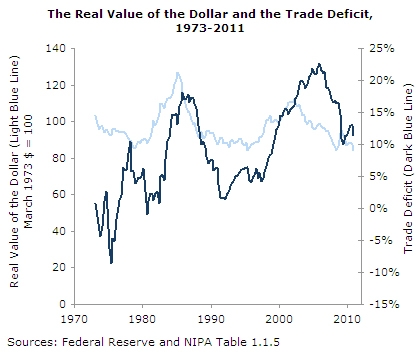
So what's the evidence on this point? Dean Rosnick offers a graph showing two big falls in the value of the dollar after peaks in the mid-80s and mid-2000s, and falls in the trade deficit a few years later, in the early 90s and late 2000s. Early 90s and late 2000s ... hm, what else was happening in those years? Oh, right, deep recessions. (The early 2000s recession was very mild.) Funny that the same guy who's constantly chastising economists for ignoring the growth and collapse of a huge housing bubble, when he turns to trade ... ignores a huge housing bubble.

Still, isn't the picture is basically consistent with the story that when the dollar declines, US imports get more expensive and fall, and US exports get cheaper and rise? Not necessarily: Dean's Rosnick's graph doesn't show imports and exports separately. And when we separate them out, we see something funny.


Click the graph to make it legible.

In a world where trade flows were mainly governed by exchange rates, a country's imports and exports would show a negative correlation. After all, the same exchange-rate change that makes exports more expensive on world markets makes imports cheaper here, and vice versa. But that isn't what we see at all. Except in the 1980s (when the exchange rate clearly did matter, but not in the way Dean Rosnick supposes; see Robert Blecker) exports and imports very clearly move together. And it's not just a matter of a long-term rise in both imports and exports. Every period that saw a significant fall in imports -- 1980-1984; 2000-2002; 2007-2009 -- saw a large fall in exports as well. This is simply not what happens in a world where prices (are the main things that) matter.

(This discrepancy between real-world trade patterns and the textbook vision applies to almost all industrialized countries, and always has. It was noticed long ago by Robert Triffin, who brought it up to argue that movements in relative price levels did not govern trade patterns under the gold standard, as Ricardo and his successors had claimed. But it is just a strong counterargument to today's conventional wisdom that exchange rates govern trade.)

So if changes in exchange rates don't drive trade, what does? Lots of things, many of them no doubt hard to measure, or to influence through policy. But one obvious candidate is changes in incomes. One of the big advances of the first generation of Keynesian economists -- people like Triffin, and especially Joan Robinson -- was to show how, just as prices (the wage and interest rates) fail to equilibrate the domestic economy, leaving aggregate income to adjust, relative prices internationally don't equilibrate the global economy, leaving output or growth rates to adjust. In the short run, business cycle-type fluctuations reliably involve changes in investment and consumer-durable purchases larger disproportionate to the change in output as a whole; given the mix of traded and non-trade goods for most countries, this creates an allometry in which short-run changes in output are accompanied by even larger short-run changes in imports and exports. For a country that runs a trade deficit in "normal" times, this means that recessions are reliably associated with smaller deficits and booms with larger ones. In the long run, there is also a reliable tendency for increments to income to involve demand for a changing mix of goods, with a greater share of demand falling on "leading sectors," historically manufactured goods. (The flipside of this is Engels' law, which states that the share of income spent on food falls as income rises.) Given that both a country's mix of industries and its trade partners are relatively fixed, this creates a stable relationship between relative growth rates and trade balance movements. Neither of these channels is perfectly reliable, by any means -- and the whole point of the industrial policy is to circumvent the second one -- but they are still much stronger influences on trade flows than exchange rates (or other relative prices) are.

So with that in mind, let's look at another version of the graph. This one shows the year-over-year change in the trade balance as a share of GDP, the same change as predicted by an OLS regression on total GDP growth over the past three years, and as predicted by the change in the value of the dollar over the past three years. [1]

It will be legible if you click it.


Not surprisingly, neither prediction gives a terribly close fit. But qualitatively, at least, the predictions based on GDP do a reasonable job: They capture every major worsening and improvement in the trade balance. True, they under-predict the improvement in the trade balance in the later 80s -- the Plaza Accords mattered -- but it's clear that if you knew the rate of GDP growth over the next three years, you could make a reasonably reliable prediction about the the behavior of the trade balance. Knowing the change in the value of the dollar, on the other hand,wouldn't help you much at all. (And just to be clear, this isn't about the particular choice of three years. Two years and four years look roughly similar, and at a one-year horizon exchange rates aren't predictive at all.)

Here's another presentation of the same data, a scatterplot comparing the three-year change in the trade balance to the three-year growth of GDP (blue, left axis) and three-year change in the exchange rate (red, right axis). Again, while the correlation is fairly loose for both, it's clearly tighter for GDP. All the periods of strongest improvement in the trade balance are associated with weak GDP growth, and vice versa; similarly all the periods of strong GDP growth are associated with worsening of the trade balance, and vice versa. There's no such consistent association for the trade balance and changes in the exchange rate.


If you want to be able to read the graph, you should click it.


The fit could be improved by using some measure of disposable income -- ideally adjusted for wealth effects -- in place of GDP, and by using some better measure of relative prices in place of the exchange-rate index -- altho there's some controversy about what that better measure would be. And theoretically, instead of just the three-year change, you should use the individual lags.

Still, the takeaway, if you're a policymaker, is clear. If you want to improve the trade balance, slower growth is the way to go. And if you want to boost growth, you probably are going to have to ignore the trade balance. Personally, I want door number two. I assume Dean Rosnick doesn't want door one. But what I'm not at all sure about, is what concrete evidence makes him think that exchange-rate policy opens up a third door.


[1] Technicalities. I separately regressed the changes in imports and exports (as a percent of GDP) over three years earlier, on the percentage change over the same period in GDP and in the Fed's trade-weighted major-partners dollar index, respectively. It's all quarterly data, downloaded from FRED. The graphs shows the predicted values from the two regressions. This is admittedly crude, but I would argue that the more sophisticated approaches are in some respects less appropriate for the specific question being addressed here. For example, suppose hypothetically that a currency devaluation really did tend to improve the trade balance, but that it also tended to raise GDP growth, raising imports and offsetting the initial improvement. From an analytic standpoint, it might be appropriate to correct for the induced GDP change to get a better estimate of the pure exchange-rate effect. But from a policy perspective, the offsetting growth-imports effect has to be taken into account in evaluating the effects of a devaluation, just as much as the initial trade-balance improvement. Maybe we should say: Academics are interested in partial derivatives, policymakers in total derivatives?


EDIT: Oops! How did I not notice that this article was by somebody named David Rosnick, not Dean Baker? Makes me feel a bit better -- I know Dean does share this article's basic view of trade and the dollar, but I would hope his take would be a little less dependent on textbook syllogisms, and a little more attentive to actual patterns of trade. Clothing from the UK is hardly representative of US imports; to the extent we do import any, it's like to be high-end branded stuff that is particularly price-inelastic.

Thursday, September 23, 2010

Roubini, Deflationist

Last week, Nouriel Roubini wrote a somewhat puzzling op-ed in the Washington Post, in support of a payroll tax cut as a stimulus measure.

It's a rather strange argument, or mix of arguments, since he's never clear whether it's a demand-side or supply-side policy. For example, he argues both that the cut should be higher for low-income workers (since they have a higher propensity to consume), and that "to maximize the incentives for private-sector hiring, there should be sharper reductions to the payroll taxes paid by employers than for those paid by employees."

But let's take the supply-side half of Roubini's argument at face value. Suppose a payroll tax cut lowered the cost of labor to employers. Is it so obvious that would increase employment?

The implicit model Roubini is using is the one every undergraduate learns, of a firm in a perfectly competitive market with increasing marginal costs. But in the real world firms face downward-sloping demand curves, especially in recessions. So the only way a reduction of labor costs can increase hiring is if it allows firms to lower costs, i.e. contributes to deflation. Does Roubini really think that more deflation is what the economy needs? (Does he even realize that's what he's arguing?)

This, anyway, was my reaction when I read the piece. But it wouldn't be worth dragging out a week-old op-ed to take shots at, if my friend Arin hadn't pointed out a recent NY Fed working paper by Gauti Eggerston making exactly this point. From the abstract: "Tax cuts can deepen a recession if the short term nominal interest rate is zero, according to a standard New Keynesian business cycle model. An example of a contractionary tax cut is a reduction in taxes on wages. This tax cut deepens a recession because it increases deflationary pressures." The paper itself involves building up a complicated model from microfoundations (that's why Eggerston gets paid the big bucks) but the underlying intuition is the same: The only way a decrease in labor costs can lead to increased hiring is by lowering prices, and under current conditions lower prices can only mean lower aggregate demand.

As Arin points out, the incoherence of the argument for payroll tax cuts may be precisely their appeal. People who think unemployment is the result of inadequate demand and people who think it's the result of lazy, overpaid workers (i.e. it's "structural") can both support them, even though the arguments are incompatible. (People who don't scruple too much over consistency can even make both arguments at once.) But if macroeconomic policy is limited to stuff that can be supported with bad arguments, we shouldn't be surprised if the results are disappointing. That lower labor costs don't help in a recession is, I guess, another lesson from the Great Depression that will have to be learned again.

As for Roubini, it's hard to improve on Jamie Galbraith's very diplomatic judgment: I cannot discern his methods.

Friday, August 13, 2010

Those Who Forget History, Are Probably Historians

There are hardly any economists or economic historians who have contributed more to our understanding of the role of international finance in the Great Depression than Barry Eichengreen and Peter Temin. [1] So it's disappointing to see them so strenuously refusing to learn from that history.

They start by correctly observing that the fatal flaw of the gold standard was the "asymmetry between countries with balance-of-payments deficits and surpluses. There was a penalty for running out of reserves .. but no penalty for accumulating gold." Thus the structural tendency toward deflation in the gold standard era, and the instability of the system once workers recognized that lower wages for "sound money" wasn't such a great deal. If Temin and Eichengreen want to draw a parallel with the Euro system today, well, I'm not sure I agree, but it's an avenue worth pursuing. But as they want to apply it, to the US and China, it's unambiguously wrong, as economics and as history.

"The point," say Temin and Eichengreen, "is not to let deficit countries off the hook." Barry, Peter -- read your books! Letting the deficit countries off the hook is exactly the point. If there's one lesson in Lessons from the Great Depression, it's that no practical response to the crisis was possible until the idea that a trade deficit represented a kind of moral failing was abandoned. The whole point, first, of leaving the gold standard, and later, of the Bretton Woods institutions, was to free deficit countries from the obligation to "live within their means" by curtailing domestic investment and consumption.

Keynes couldn't have been clearer on this. The goal of postwar monetary reform, he wrote, was "A system which would maintain balance of payments equilibrium without trade discrimination but also without forcing unemployment .. on deficit countries," [2] in other words, a system in which governments' efforts to pursue full employment was not constrained by the balance of payments. We needn't take Keynes as holy writ, but if we're going to analyze current arrangements in light of his writings in the 1940s, as Temin and Eichengreen claim to, we have to be clear about what he was aiming for.

One would expect, then, that they would go on to show how "global imbalances" are constraining national efforts to pursue full employment. But they don't even try. Instead, they offer ambiguous phrases whose vagueness is a sign, perhaps, of a bad conscience: Keynes "wanted measures to deal with chronic surplus countries." What kind of surpluses, exactly? and deal with how?

The beginning of wisdom here is the to recognize the distinction between the balance of payments and the current account. Keynes was concerned with the former, not the latter. Keynes didn't care if some countries ran trade surpluses or deficits, temporarily or persistently; what he cared about was that these imbalances did not interfere with other countries' freedom "to pursue full employment and progressive social policies." In other words, current account imbalances were not a problem as long as the financial flows to finance them were guaranteed.

"Creditor adjustment" is rightly stressed by Eichengreen and Temin as a central feature of Keynes' vision of postwar monetary arrangements, but they seem to have forgotten what it meant. It didn't mean no one could run a trade surplus, it just meant that the surplus countries would be obliged to lend to the deficit ones as much as it took to finance the trade imbalances. As Keynes' follower Roy Harrod put it,"The most important requirement [is] to get the United States committed to creditor adjustment. .... Creditor adjustment could be secured most simply by an agreement that the creditor would always accept cheques from the deficit countries in full discharge of their debts. ... So long as their credit position cannot cause pressure elsewhere, there is no harm in allowing a further accumulation.” All of Keynes' proposals at Bretton Woods were oriented toward committing the countries with surpluses to lend, at concessionary rates if necessary, to the deficit ones.

China today accepts American checks in full discharge of our debts; they don't demand payment in gold. The Chinese surplus isn't putting upward pressure on US interest rates, or constraining public spending. All Keynes ever wanted was for all surplus countries to be like China.

"Sixty-plus years later, we seem to have forgotten Keynes' point," Eichengreen and Temin conclude. True that.


[1] The strangely forgotten Robert Triffin is one.

[2] The historical material in this post post, including all quotes, is drawn from chapters 6 and 9 of the third volume of Robert Skidelsky's biography of Keynes.

Thursday, August 12, 2010

Keyes Is Right

Alan Keyes says, "If citizenship is not a birthright then it must be a grant of the government. And if it is a grant of the government, it could curtail that grant in all the ways that fascists and totalitarians always want to."

In other words, the rights vis-a-vis the state we call citizenship, are prior to the legal acts that formalize them.

Joshua Micah Marshall thinks that's "dramatically crazier than any of the opinions on offer," since Keyes attributes the priority of citizenship, in part, to God.

But as a historical matter, Keyes is certainly right. The founding documents of political liberalism -- the Declaration of the Rights of Man and Citizen, the Declaration of Independence -- explicitly state that the rights of the citizen are prior to their recognition by governments. If a government fails to recognize them, it's that government's legitimacy that is diminished, not the rights of the citizen.

In the specific 14th Amendment context, the point is that the right of the freedmen to citizenship wasn't created by the 14th Amendment, but already existed by virtue of their living in this country and being subject to its laws. Did Congress have the power or the authority to deny them citizenship? Seems to me the Civil War answered that question clearly in the negative. The law binds most of the time, but ultimately it derives its authority from a set of norms that are prior to it.

This is certainly how the founders of liberal political orders, here and elsewhere, understood the relationship between the rights of the citizen and the law. That's why they were ready to overthrow existing governments by force. Of course today it's the Constitution and the law that regulate citizenship. But it's important to remember that the fact that we -- or almost anyone else -- are citizens at all is not the result of legal or constitutional acts.

EDIT: It's funny that reference to the founding documents of political liberalism is these days almost a monopoly of conservatives. Of course it's not so strange, since conservatism is backward-looking by nature, while progressives naturally believe in progress. But the DNA of liberalism hasn't changed that much, and Jefferson, Madison, and Hamilton, Lafayette and Saint-Just, and other Enlightenment political figures expressed it pretty robustly.

Unlike their forebears, modern liberals tend to insist on the absolute autonomy of the law in general, and the Constitution in particular. They're unwilling, for obvious reasons, to accept a political order grounded on divine revelation, but they don't have any alternative ground to put it on, so it ends up floating in the air. (Carl Schmitt is very good on this.) There's what's useful, and there's what's legal, under the law as it exists; but there's no category of political legitimacy behind the law. Given the remarkable political stability of the United States since the Civil War, and just as important, as Herbert Croly emphasized, the continuously rising standard of living here, we've mostly gotten along fine without one. But one suspects that it wouldn't take that much political strain for "government by lawyers" (Croly's phrase) to experience its Wile E. Coyote moment, when it turns out that the authority of the law wasn't underpinned by anything but a lack of good reasons to question it. Not unlike, perhaps, what happened in the financial crisis of 2008, when it turned out that not only did the traditional tools of monetary policy not work, they'd stopped working some time before.