Showing posts with label exchange rates. Show all posts

Tuesday, October 1, 2013

Default and the Dollar

Government shutdown, debt ceiling deadline just around the corner. Were you watching this show when it was first on, in the summer of 2011? People were predicting that even the possibility of a technical default (which almost happened), or credit-rating downgrade (which did happen, on Aug. 11) should lead to a sharp rise in US interest rates and a fall in the dollar. Neither of these things took place. There were some interesting discussions why not, which are worth revisiting now.

Here is something I wrote at the time:
How is it possible that a downgrade in federal debt could increase demand for it? One obvious reason is that it could increase the political pressure for austerity, making lower growth more likely, and owners of financial assets might recognize this.
But there's another explanation, which is the that federal debt is a kind of Giffen good. This Baseline Scenario post makes one version of the argument. Here's my version. 
Wealthholders choose their portfolio to maximize risk-adjusted return, but subject to a survival constraint such that expected probability of returns at each future time t falling below some floor is subjectively zero (less than epsilon, we can say.) The existence of this kind of floor is one of the central things that distinguishes the Minskyan view of the world. (Minsky would talk here about cashflows rather than returns, but the logic is the same.) 
Now suppose the riskiness of the portfolio increases. Then to keep the distribution of returns from crossing the floor, investors need to shift toward lower-risk assets. This is true even if the increased riskiness of the portfolio came from the lower risk assets themselves. 
Here's another way of looking at it, more in the spirit of Holmstrom and Tirole. Making a risky/illiquid investment requires holding a greater quantity of money-like assets to ensure a zero (or less than epsilon) probability of the investment pulling you below your survival constraint. In effect, this lowers the return on the investment, since the total return has to be calculated on the cost of the asset itself plus the cushion of money-like assets you need to purchase along with it. If safe assets are less safe, you have to hold more of them to cushion the same risky asset. This means that an increase in the riskiness of safe assets implies a shift in demand toward safe assets and away from risky ones.

I also wrote this, about the appreciation of the dollar following the downgrade:
There was a very interesting piece from the BIS recently about why a fall in the price of US assets may be associated with an appreciation of the dollar. (It's the McCauley chapter in the linked document.) They argue that many purchasers of dollar assets wanted the asset, not the foreign-exchange risk, so they hedged it by simultaneously selling the dollar forward, or otherwise issuing a dollar liability of equal value to the asset. But this means if the value of the US asset declines, they are overhedged, they now have a short position in the dollar. To get rid of that foreign-exchange risk they have to liquidate the dollar liability, which means buying dollars. 
If this sort of hedging were universal, it would have somewhat counterintuitive implications for the exchange rate. Changes in demand for dollar assets would then have no effect on the value of the dollar. And changes in the dollar value of US assets would induce opposite-signed changes in the value of the dollar. According to the BIS, this kind of hedging is very common among European investors in US assets, but not at all common among US purchasers of foreign assets -- for US purchasers, the foreign-exchange risk is part of the asset, not something they want to get rid of.
I don't see any reason to have a strong prior that hedging the forex risk cannot be common among purchasers of foreign assets. If it is common, this sort of "perverse" movement of exchange rates in response to asset-price changes is not just possible, but predictable. And if the hedging is asymmetric, as the BIS study suggests, then we would expect a global rise in asset prices to lead to a decline in the value of the dollar, and a global fall in asset prices to lead to a rise in the price of the dollar.  
Going a step beyond the BIS study, I think there's a sociological element here. Actual portfolio choices are very seldom made by the ultimate owners, they're made by intermediaries who are typically specialists of some kind. Now if, let's say, European purchasers of US equities are largely made by intermediaries, who specialize in equities (domestic and foreign), then they're going to want to hedge the forex risk -- that's not what they have the expertise to manage. Whereas if US purchases of European equities are largely made by intermediaries who specialize in European or in general foreign assets (equities and otherwise) then they are not going to want to hedge the forex risk, managing it is part of how they get their returns. And I think this question is going to depend on the specific kinds of financial institutions that have developed historically in each place, you can't deduce it from any underlying tastes or endowments.  
But in any case I think we have to accept that it's perfectly possible for a decline in the value of US assets to lead to a rise in the value of the dollar, even if it seems implausible at first glance.

Monday, September 16, 2013

Exchange Rates and Trade Flows in Asia


A bit more on shifting trade flows following the 1997 Asian Crisis.

Enno Schroeder, whose decomposition  of European trade flows I've mentioned here before, was kind enough to do a similar exercise for the four Asian crisis countries. His results are here; below I present them in graphical form below.

The conventional story, as we all know, is that relative prices drive trade flows. The Asian countries, in this view, moved from deficits to surpluses after 1997 because abandoning their currency pegs and devaluing made their exports cheaper and their imports more expensive. I've been suggesting a different story: Relative prices were relatively unimportant in the post-1997 move to surpluses, with the improved trade balance mostly or entirely a matter of lower imports resulting from the deep fall in income in the crisis. Looking at the picture in more detail suggests a more complex but in some ways even stronger version of my earlier story.

Some context: Suppose a country reduces its total import bill. As a matter of accounting, this reduction can be broken up into some mix of lower total quantity of goods bought, a smaller fraction of those goods being imports, and a lower price of the imported goods. Similarly for exports, any increase can be broken up into higher incomes in a country's export markets, a greater market share there for our exports, and higher export prices. So the overall trade balance -- here expressed as the ratio of total export value to total import value -- can be decomposed into the change in relative expenditure growth, the expenditure switch between the home country's goods and the rest of the world's; and the change in the relative price of home goods compared with foreign ones. (Note that relative price presumably affects trade volumes, but it also affects trade value directly -- for given trade volumes, if a country's imports are more expensive it will spend more on imports.) The cumulative contribution of each of these components is shown in the figures below, along with the nominal exchange rate. (The exchange rate is the nominal rate for July of each year, from the BIS.)

The heavy black line is the actual trade balance. Again, since the balance here is expressed as the ratio of exports to imports, a value of 1 means balanced trade. The other three solid lines show the cumulative contributions of each component to the changes in trade flows after 1996; the values represent how the trade ratio would have changed from that factor alone. Yellow is expenditure switch, from the rest of the world's goods to the home country's; this includes both home country switch from imports to domestic goods, and foreign country shift toward the home country's exports. Green is income growth in the country's trade partners relative to the home country. The solid red line is the terms of trade. The dotted red line shows the cumulative change in the nominal exchange rate; this isn't directly a contribution to the change in trade flows, but it's useful to know how closely the change in the terms of trade tracks the exchange rate.

It's convenient to think of the difference between the black line and the green line as the change in competitiveness.

The immediate effect of a devaluation is to make the home country's goods cheaper in the rest of the world, and the rest of the world's goods more expensive in the home country. The direct effect of this is to move the trade balance further toward deficit -- a descending red line in the figures below. But in the conventional story, the change in price leads to a more than proportionate change in quantity -- a rise in exports and/or a fall in imports -- so that the overall trade balance improves. This should show up here as a rise in the yellow line steeper than the fall in the red one. Income growth doesn't really come into the conventional story, so the green line should be flat.

This is not what we see. Even in terms of this simple decomposition, the post-crisis experience of each of the four Asian NICs was different, but none of them fit the standard story. Devaluations don't reliably translate into changes in the terms of trade, and changes in the terms of trade don't reliably translate into changes in trade flows. The income-trade balance link, on the other hand, looks quite reliable. In terms of the debate taking place elsewhere in econ blog land, this is a case where "hydraulic Keynesianism" looks pretty good.

Thailand is the clearest picture.


In the 1997 devaluation, the baht lost about a third of its value; the fall in the terms of trade -- the price of Thai exports relative to imports -- was less than proportionate, but still substantial. You can see this in the red lines at the bottom. But there was no expenditure switch at all. The flat yellow line shows that expenditure on foreign goods out of a given Thai income, and expenditure on Thai goods out of a given income elsewhere, did not change at all in the ten years after the crisis. (More precisely, expenditure in Thailand shifted toward domestic goods, while Thailand lost ground in its export markets; the two effects approximately canceled out.) Given that Thai goods were getting cheaper relative to foreign goods, the lack of net expenditure switch toward Thai goods should have led to deeper deficits. The only reason Thailand moved from deficit to surplus, is the decline in expenditure in Thailand relative to expenditure in its trading partners. The close match between the black and the green line in the figure, means that essentially the whole change in Thailand's trade balance is explained by the change in relative growth rates; there was no net switch toward Thai goods from foreign goods.


Indonesia is in some ways even a starker example:

Here we see a very deep devaluation, but again only a moderate change in the terms of trade, and an even smaller response of trade volumes. As in Thailand, the trade balance basically tracks relative income growth. The difference between these two cases is where the devaluation-trade flows link fails. In Thailand, the devaluation did reduce the price of exports relative to imports, but demand was not price-elastic enough for the change in prices to improve the trade balance. (In other words, the Marshall-Lerner-Robinson condition appears not to have been satisfied.) In Indonesia, the even larger devaluation -- the rupiah lost almost 80 percent of its value -- failed to change relative prices of traded goods, so demand elasticities did not come into play. This is partly because of high inflation in Indonesia following the devaluation, but not entirely - the rupiah fell by nearly half in real terms. But there was no change in the price of Indonesia's exports relative to its imports. If you want an example of a devaluation not working, this is a good one.


Korea, by contrast, looks superficially like the devaluation success story.


As I mentioned in the previous post, Korea was the only one of these countries where export growth in the decade after 1997 was as fast as in the decade before. And as the figure here shows, there was a substantial shift expenditure toward Korean goods following the crisis; alone among the four countries, Korea achieved its immediate post-crisis improvement in trade balance mainly through favorable expenditure switch rather than solely through a fall in income (though that contributed too.) But over time, Korea's terms of trade continued to deteriorate, without any further favorable expenditure switch; meanwhile, Korean growth slowed relative to its trade partners. By 2007, expenditure shares were back at 1997 levels; to the extent that Korea's trade balance was more favorable, it was only because spending was lower relative to its trade partners. Of course the surpluses it had run in the meantime had allowed the accumulation of substantial foreign exchange reserves. But if the goal is to use a lower exchange rate to achieve a permanent shift in trade balances, Korea post-1997 cannot be considered a success.

I should emphasize here: Slower relative expenditure growth in Korea does not mean slow growth in absolute terms. In fact, Korea (and, to varying degrees, the other three) did enjoy strong post-crisis recoveries. But because by far the largest trading partner for these countries is China -- taking about 25% of their exports -- even fairly strong growth translated into low relative growth. In other words, rapid growth in China implied growing exports in the NICs even in the absence of any competitiveness gains.


Finally, the one country that did achieve a lasting improvement in competitiveness, Malaysia.


In the immediate crisis period, Malaysia looks like Thailand and Indonesia: A deep devaluation fails to pass through to the relative prices of traded goods, and there is no expenditure switching; instead, the entire burden of raising the trade balance falls on slower growth in domestic expenditure. In the case of Malaysia, domestic expenditure fell by an astonishing 28 percent in 1997, a collapse in economic activity that has few precedents -- neither the US in the 1930s nor any Euro-crisis country comes close. But in the case of Malaysia, unlike the other three countries, growth subsequently accelerated relative to its trade partners, reflected in the downward sloping green line; at the same time, there was a continued expenditure switch in favor of Malaysian goods, reflected in the upward slope of the yellow line. What's especially striking about this competitiveness success story is that the favorable expenditure switch happened despite a rising price of of Malaysia's exports relative to its imports.

To continue with this analysis properly, one would want to disaggregate imports and exports by sector or industry. And would want to study, for each country, the institutional and legal changes that influenced trade flows in the decade after 1997. But failing that, it's at least worth understanding what the aggregate numbers are saying. It seems to me that they are saying this:

Even a very deep devaluation, as in Indonesia, is not guaranteed to change the relative prices of a country's imports and exports.

Even if a devaluation is passed through to relative prices, as in Thailand, price elasticities may not be large enough to produce a favorable change in the trade balance.

Even if a devaluation moves relative prices, and demand is price-elastic enough for the price change to move the trade balance in the right direction, as in Korea, a short-term improvement in competitiveness may not persist.

When countries do achieve a long-term improvement in competitiveness, like Malaysia, they don't necessarily do so through a relative cheapening of exports compared to imports. On the contrary: If the Marshall-Lerner condition is not satisfied, then a relative increase in the price of a country's exports will raise export earnings. In the case of Malaysia, improved terms of trade (that is, a rise in the price of its exports relative to its imports) account for about half the long-run improvement in its trade balance.

The Asian precedent does not make a Greek (or Spanish, or Portuguese, or Irish) devaluation look like an obviously good idea.

----

One other thing, if even real exchange rate changes are not passed through to traded-good prices in the destination country, then they must be showing up as changes in exporter profit margins. This shifts the focus from demand responses to supply responses, which I would argue are  more institutionally mediated. As you can tell if you've read this far, I am sympathetic to the "elasticity-pessimist" strand of Post Keynesian thought. But on the other side Robert Blecker has a strong argument for a strong effect of exchange rate changes, focusing on the role of export-industry profits in financing investment. Blecker's paper, in my opinion, is more convincing the straightforward "prices matter" view of exchange rate changes. But it also suggests a certain asymmetry: low profits induce exit from tradable sectors, especially for countries with Anglo-American market-based financial systems, more reliably than high profits encourage entry.


UPDATE: The fact that even large exchange rate changes produce relatively small movements in the relative prices of traded goods is well-known in the empirical trade literature. See for example here. I should have made this clearer.


Tuesday, September 3, 2013

The Mirage of Devaluation

The papers are full of the rupee crisis. India's worst economy in decades, supposedly.

The silver lining, according to this morning's FT, is that the fall in the rupee should eventually boost exports. After all, after the the 1997 Asian crisis, "countries like Thailand and Malaysia enjoyed export-led recoveries following wrenching devaluations." Is that so?

The devaluation part is right -- all these countries saw their currencies fall steeply when they abandoned their pegs in the second half of 1997, typically losing about half their value against the dollar. The supposed export-led recoveries are a different story.

Annual growth of export volumes and average rates for the decades before and after 1997, Malaysia and Thailand. Source: IMF.

The solid lines in the figure above are the annual growth rates of export volumes. The dotted lines are the average rates for the ten years prior to and following the 1997 crisis. As you can see, export growth was substantially slower after the crisis than before -- in both Malaysia and Thailand, export growth after devaluation was about half the previous pace. In Indonesia, whose currency fell even more, export growth essentially ceased -- from 8 percent annual rates before 1997 to less than 1 percent in the decade following. And these are volumes; given the devaluation, foreign exchange earnings did even worse. In Thailand, for instance, exports earnings in dollars were still lower in early in 2002 than they had been before the crisis, almost five years before. For Indonesia, export earnings were still at their pre-crisis levels as late as 2004. This is about as far from an export boom as you can get.

You can argue, I suppose, that without the devaluations export performance would have been even worse. But you cannot claim that faster export growth following the devaluations boosted demand, because no such faster growth occurred.

It's really remarkable how much the devaluation-export growth link is taken for granted in discussions of foreign trade. But in the real world, for whatever reason, the link is often weak or nonexistent.

Practical policymakers seem to have an easier time grasping this than economists. There's a reason why falling currencies are seen as major problems in much of the developing world, even though they supposedly should boost exports. And there's a reason, presumably, why the leaders of Syriza, hardly slaves to conventional wisdom, have ignored the advice from progressive American economists that Greece would be better off out of the Euro.

Friday, November 9, 2012

Demand and Competitiveness: Germany and the EU

I put up a post the other day about Enno Schroder's excellent work on accounting for changes in trade flows. Based on the comments, there's some confusion about the methodology. That's not surprising: It's not complicated, but it's also not a familiar way of looking at this stuff, either within or outside the economics profession. Maybe a numerical example will help?

Let's consider two trading partners, in this case Germany and the rest of the EU. (Among other things, having just two partners avoids the whole weighting issue.) The first line of the table below shows total demand in each -- that is, all private consumption, government consumption, and investment -- in billions of euros. (As usual, this is final demand -- transfers and intermediate goods are excluded.) So, for instance, in the year 2000 all spending by households, firms and governments in Germany totaled 2.04 trillion euros. The next two lines show the part of that expenditure that went to imports -- from the rest of the EU for Germany, from Germany for the rest of the EU, and from the rest of the world for both. The final two lines of each panel then show the share of total expenditure in each place that went to German and rest-of-EU goods respectively. The table looks at 2000 and 2009, a period of growing surpluses for Germany.


2000 2009

Germany Demand 2,041 2,258


Imports from EU 340 429


Imports from Rest of World 198 235


Germany Share 74% 71%


EU ex-Germany Share 17% 19%

EU ex-Germany Demand 9,179 11,633


Imports from Germany 387 501


Imports from Rest of World 795 998


Germany Share 4% 4%


EU ex-Germany Share 87% 87%


Ratio, Germany-EU Exports to Imports 1.14 1.17

EU Surplus, Percent of German GDP 2.27 3.02


So what do we see? In 2000, 74 cents out of every euro spent in Germany went for German goods and services, and 17 cents for goods and services from the rest of the EU. Nine years later, 71 cents out of each German euro went to German stuff, and 19 cents to stuff from the rest of the EU. German households, businesses and government agencies were buying more from the rest of Europe, and less from their own country. Meanwhile, the rest of Europe was spending 4 cents out of every euro on goods and services from Germany -- exactly the same fraction in 2009 as in 2000.

If Germans were buying more from the rest of the EU, and non-German Europeans were buying the same amount from Germany, how could it be that the German trade surplus with the rest of Europe increased? And by nearly one percent of German GDP, a significant amount? The answer is that total expenditure was rising much faster in the rest of Europe -- by 2.7 percent a year, compared with 1.1 percent a year in Germany. This is what it means to say that the growing German surplus is entirely accounted for by demand, and that Germany actually lost competitiveness over this period.

Again, these are not estimates, they are the actual numbers as reported by EuroStat. It is simply a matter of historical fact that Germans spent more of their income on goods from the rest of the EU, and less on German goods, in 2009 than in 2000, and that the rest of the EU spent the same fraction of its income on German goods in the two years. Obviously, this does not rule out the possibility that German goods were becoming cheaper relative to the rest of Europe's, if you postulate some other factor that would have reduced Germany's exports without a growing cost advantage. (This is not so easy, since Germany's exports are the sort of high-end manufactures which usually have a high income elasticity, i.e. for which demand is expected to rise over time.) And it is also compatible with a story where German export prices fell, but export demand is price-inelastic, so that lower prices did nothing to raise export earnings. But it is absolutely not compatible with a simple story where the most important driver of German trade imbalances is changing relative prices. For that story to work, the main factor in Germany's growing surpluses would have to have been expenditure switching from other countries' goods to Germany's. And that didn't happen.


NOTE: This my table, not Enno's. The data is from Eurostat, while he uses the Penn World Tables, and he does not look at intra-European trade specifically.


UPDATE: There's another question, which no one asked but which you should always try to answer: Why does it matter? The truth is, a big reason I care about this is that I'm curious how capitalist economies work, and this stuff seems to shed some light on that, in terms of both the specific content  and the methodology. But more specifically:

First, seeing trade flows as driven by income as well as price fits better with a vision of economy that has many different possible states of rest. It fits better with a vision of economies evolving in historical time, rather than gravitating toward an equilibrium which is both natural and optimal. In this particular case, there is no reason to suppose that the relative growth rates consistent with full employment in each country are also the relative growth rates consistent with balanced trade. A world in which trade flows respond mainly to relative prices is a world where macropolicy doesn't pose any fundamentally different challenges in an open economy than in a closed one. Whatever mechanisms operated to ensure full employment continue to do so, and then the exchange rate adjusts to keep trade flows balanced (or appropriately unbalanced, for a country with a good reason to export or import capital.) Whereas when the main relationship is between income and trade, they cannot vary independently.

Second, there are important implications for policy. Krugman keeps saying that Germany needs higher relative prices, i.e., higher inflation. Even leaving aside the political difficulties with such a program, it makes sense on its own terms only if there is a fixed pool of European demand. To say that the only way you can have an adequate level of demand in Greece is for prices to fall relative to Germany, is to accept, on a European or global level, the structural theory of unemployment that Krugman rejects so firmly (and rightly) for the US. By contrast if competitiveness didn't cause the problem, we shouldn't assume competitiveness is involved in the solution. The historical evidence suggests that more rapid income growth in Germany will be sufficient to move its current account back to balance. The implications for domestic demand in Germany are the opposite in this case as in the relative-prices case: Fixing the current account problem means more jobs and orders for German workers and firms, not  higher inflation in Germany. [1]

So if you buy this story, you should be more pessimistic about a Greek exit from the euro -- since there's less reason to think that flexible exchange rates will lead to balanced trade -- but more optimistic about a solution within the euro.

I don't understand why, for economists like Krugman and Dean Baker, Keynesianism always seems to stop at the water's edge. Why does their analysis of international trade always implicitly [2] assume a world economy continually at full capacity, where a demand shortfall in one country or region implies excess demand somewhere else? They know perfectly well that the question of unemployment in one country cannot be reduced to the question of who is getting paid too much; why do they forget it as soon as exchange rates come into the picture? Perhaps it's for the same reasons -- whatever they are -- that so many economists who support all kinds of domestic regulation are ardent supporters of free trade, even though that's just laissez-faire at the global level. In the particular case of Krugman, I think part of the problem is that his own scholarly work is in trade. So when the conversation turns to trade he loses one of the biggest assets he brings to discussions of domestic policy -- a willingness to forget all the "progress" in economic theory over the past 30 or 40 years.

[1] A more reasonable version of the higher-prices-in-Germany claim is that Germany must be willing to accept higher inflation in order to raise demand. In some times and places this could certainly be true. But I don't think it is for Germany, given the evident slack in labor markets implied by stagnant wages. And in any case that's not what Krugman is saying -- for him, higher inflation is the solution, not an unfortunate side effect.

[2] Or sometimes explicitly -- e.g. this post has Germany sitting on a vertical aggregate supply curve.

Monday, November 5, 2012

What Drives Trade Flows? Mostly Demand, Not Prices

I just participated (for the last time, thank god) in the UMass-New School economics graduate student conference, which left me feeling pretty good about the next generation of heterodox economists. [1] A bunch of good stuff was presented, but for my money, the best and most important work was Enno Schröder's: "Aggregate Demand (Not Competitiveness) Caused the German Trade Surplus and the U.S. Deficit." Unfortunately, the paper is not yet online -- I'll link to it the moment it is -- but here are his slides.

The starting point of his analysis is that, as a matter of accounting, we can write the ratio of a county's exports to imports as :

X/M = (m*/m) (D*/D)

where X and M are export and import volumes, m* is the fraction of foreign expenditure spent on the home country's goods, m is the fraction of the home expenditure spent on foreign goods, and D* and D are total foreign and home expenditure.

This is true by definition. But the advantage of thinking of trade flows this way, is that it allows us to separate the changes in trade attributable to expenditure switching (including, of course, the effect of relative price changes) and the changes attributable to different growth rates of expenditure. In other words, it lets us distinguish the changes in trade flows that are due to changes in how each dollar is spent in a given country, from changes in trade flows that are due to changes in the distribution of dollars across countries.

(These look similar to price and income elasticities, but they are not the same. Elasticities are estimated, while this is an accounting decomposition. And changes in m and m*, in this framework, capture all factors that lead to a shift in the import share of expenditure, not just relative prices.)

The heart of the paper is an exercise in historical accounting, decomposing changes in trade ratios into m*/m and D*/D. We can think of these as counterfactual exercises: How would trade look if growth rates were all equal, and each county's distribution of spending across countries evolved as it did historically; and how would trade look if each country had had a constant distribution of spending across countries, and growth rates were what they were historically? The second question is roughly equivalent to: How much of the change in trade flows could we predict if we knew expenditure growth rates for each country and nothing else?

The key results are in the figure below. Look particularly at Germany,  in the middle right of the first panel:


The dotted line is the actual ratio of exports to imports. Since Germany has recently had a trade surplus, the line lies above one -- over the past decade, German exports have exceed German imports by about 10 percent. The dark black line is the counterfactual ratio if the division of each county's expenditures among various countries' goods had remained fixed at their average level over the whole period. When the dark black line is falling, that indicates a country growing more rapidly than the countries it exports to; with the share of expenditure on imports fixed, higher income means more imports and a trade balance moving toward deficit. Similarly, when the black line is rising, that indicates a country's total expenditure growing more slowly than expenditure its export markets, as was the case for Germany from the early 1990s until 2008. The light gray line is the other counterfactual -- the path trade would have followed if all countries had grown at an equal rate, so that trade depended only on changes in competitiveness. When the dotted line and the heavy black line move more or less together, we can say that shifts in trade are mostly a matter of aggregate demand; when the dotted line and the gray line move together, mostly a matter of competitiveness (which, again, includes all factors that cause people to shift expenditure between different countries' goods, including but not limited to exchange rates.)

The point here is that if you only knew the growth of income in Germany and its trade partners, and nothing at all about German wages or productivity, you could fully explain the German trade surplus of the past decade. In fact, based on income growth alone you would predict an even larger surplus; the fraction of the world's dollars falling on German goods actually fell. Or as Enno puts it: During the period of the German export boom, Germany became less, not more, competitive. [2] The cases of Spain, Portugal and Greece (tho not Italy) are symmetrical: Despite the supposed loss of price competitiveness they experienced under the euro, the share of expenditure falling on these countries' goods and services actually rose during the periods when their trade balances worsened; their growing deficits were entirely a product of income growth more rapid than their trade partners'.

These are tremendously important results. In my opinion, they are fatal to the claim (advanced by Krugman among others) that the root of the European crisis is the inability to adjust exchange rates, and that a devaluation in the periphery would be sufficient to restore balanced trade. (It is important to remember, in this context, that southern Europe was running trade deficits for many years before the establishment of the euro.) They also imply a strong criticism of free trade. If trade flows depend mostly or entirely on relative income, and if large trade imbalances are unsustainable for most countries, then relative growth rates are going to be constrained by import shares, which means that most countries are going to grow below their potential. (This is similar to the old balance-of-payments constrained growth argument.) But the key point, as Enno stresses, is that both the "left" argument about low German wage growth and the "right" argument about high German productivity growth are irrelevant to the historical development of German export surpluses. Slower income growth in Germany than its trade partners explains the whole story.

I really like the substantive argument of this paper. But I love the methodology. There is an econometrics section, which is interesting (among other things, he finds that the Marshall-Lerner condition is not satisfied for Germany, another blow to the relative-prices story of the euro crisis.) But the main conclusions of the paper don't depend in any way on it. In fact, the thing can be seen as an example of an alternative methodology to econometrics for empirical economics, historical accounting or decomposition analysis. This is the same basic approach that Arjun Jayadev and I take in our paper on household debt, and which has long been used to analyze the historical evolution of public debt. Another interesting application of this kind of historical accounting: the decomposition of changes in the profit rate into the effects of the profit share, the utilization rate, and the technologically-determined capital-output ratio, an approach pioneered by Thomas Weisskopf, and developed by others, including Ed WolffErdogan Bakir, and my teacher David Kotz.

People often say that these accounting exercises can't be used to establish claims about causality. And strictly speaking this is true, though they certainly can be used to reject certain causal stories. But that's true of econometrics too. It's worth taking a step back and remembering that no matter how fancy our econometrics, all we are ever doing with those techniques is describing the characteristics of a matrix. We have the observations we have, and all we can do is try to summarize the relationships between them in some useful way. When we make causal claims using econometrics, it's by treating the matrix as if it were drawn from some stable underlying probability distribution function (pdf). One of the great things about these decomposition exercises -- or about other empirical techniques, like principal component analysis -- is that they limit themselves to describing the actual data. In many cases -- lots of labor economics, for instance -- the fiction of a stable underlying pdf is perfectly reasonable. But in other cases -- including, I think, almost all interesting questions in macroeconomics -- the conventional econometrics approach is a bit like asking, If a whale were the top of an island, what would the underlying geology look like? It's certainly possible to come up with a answer to that question. But it is probably not the simplest way of describing the shape of the whale.


[1] A perennial question at these things is whether we should continue identifying ourselves as "heterodox," or just say we're doing economics. Personally, I'll be happy to give up the distinct heterodox identity just as soon as economists are willing to give up their distinct identity and dissolve into the larger population of social scientists, or of guys with opinions.

[2] The results for the US are symmetrical with those for Germany: the growing US trade deficit since 1990 is fully explained by more rapid US income growth relative to its trade partners. But it's worth noting that China is not: Knowing only China's relative income growth, which has been of course very high, you would predict that China would be moving toward trade deficits, when in fact it has ben moving toward surplus. This is consistent with a story that explains China's trade surpluses by an undervalued currency, tho it is consistent with other stories as well.

Thursday, May 24, 2012

Prices and the European Crisis, Continued

In comments to yesterday's post on exchange rates and European trade imbalances, paine (the e. e. cummings of the econosphere) says,
pk prolly buys your conclusion. notice his post basically disparaging forex adjustment solutions on grounds of short run impact. but long run adjustment requires forex changes.
I don't know. I suppose we all agree that exchange rate changes won't help in the short run (in fact, I'm not sure Krugman does agree), but I'm not convinced exchange rate changes will make much of a difference even in the long run; and anyway, it matters how long the long run is. When the storm is long past the ocean is flat again, and all that.

Anyway, what Krugman actually wrote was
We know that huge current account imbalances opened up when capital rushed to the European periphery after the euro was created, and reversing those imbalances must involve a large real devaluation.
We "know," it "must": not much wiggle room there.

So this is the question, and I think it's an important one. Are trade imbalances in Europe the result of overvalued exchange rates in the periphery, and undervalued exchange rates in the core, which in turn result from the financial flows from north to south after 1999? And are devaluations in Greece and the other crisis countries a necessary and sufficient condition to restore a sustainable balance of trade?

It's worth remembering that Keynes thought the answer to these kinds of questions was, in general, No. As Skidelsky puts it in the (wonderful) third volume of his Keynes biography, Keynes rejected the idea of floating exchange rates because
he did not believe that the Marshall-Lerner condition would, in general, be satisfied. This states that, for a change in the value of a country's currency to restore equilibrium in its balance of payments, the sum of the price elasticities for its exports and imports must be more than one. [1] As Keynes explained to Henry Clay: "A small country in particular may have to accept substantially worse terms for its exports in terms of its imports if it tries to force the former by means of exchange depreciation. If, therefore, we take account of the terms of trade effect there is an optimum level of exchange such that any movement either way would cause a deterioration of the country's merchandise balance." Keynes was convinced that for Britain exchange depreciation would be disastrous...
Keynes' "elasticity pessimism" is distinctly unfashionable today. It's an article of faith in open-economy macroeconomics that depreciations improve the trade balance, despite rather weak evidence. A recent mainstream survey of the empirical literature on trade elasticities concludes,
A typical finding in the empirical literature is that import and export demand elasticities are rather low, and that the Marshall-Lerner (ML) condition does not hold. However, despite the evidence against the ML condition, the consensus is that real devaluations do improve the balance of trade
Theory ahead of measurement in international trade!

(Paul Davidson has a good discussion of this on pages 138-144 of his book on Keynes.)

The alternative view is that the main relationship is between trade flows and growth rates. In models of balance-of-payments-constrained growth, countries' long-term growth rates depend on the ratio of export income-elasticity of demand and import income-elasticity of demand. More generally, while a strong short-run relationship between exchange rates and trade flows is clearly absent, and a long-run relationship is mostly speculative, the relationship between faster growth and higher imports (and vice versa) is unambiguous and immediate. [2]

So let's look at some Greek data, keeping in mind that Greece is not necessarily representative of the rest of the European periphery. The picture below shows Greece's merchandise and overall trade balance as percent of GDP (from the WTO; data on service trade is only available from 1980), the real exchange rate (from the BIS) and real growth rate (from the OECD; three-year moving averages). Is this a story of prices, or income?


The first thing we can say is that it is not true that Greek deficits are a product of the single currency.  Greece has been running substantial trade deficits for as far back as the numbers go. Second, it's hard to see a relationship between the exchange rate and trade flows. It's especially striking that the 20 percent real depreciation of the drachma from the late 1960s to the early 1970s -- quite a large movement as these things go -- had no discernible effect on Greek trade flows at all. The fall in income since the crisis, on the other hand, has produced a very dramatic improvement in the Greek current account, despite the fact that the real exchange rate has appreciated slightly over the period. It's very hard to look at the right side of the figure and feel any doubt about what drives Greek trade flows, at least in the short run.

Now, it is true that, prior to the crisis, the Euro era was associated with somewhat larger Greek trade deficits than in earlier years. (As I mentioned yesterday, this is entirely due to increased imports from outside the EU.) But was this due to the real appreciation Greece experienced under the Euro, or to the faster growth? It's hard to judge this just by looking at a figure. (That's why God gave us econometrics -- though to be honest I'm a bit skeptical about the possibility of getting a definite answer here.) But here's a suggestive point. Greece's real exchange rate appreciated by 25 percent between 1986 and 1996. This is even more than the appreciation after the Euro. Yet that earlier decade saw no growth of the Greek trade deficit at all. It was only when Greek growth accelerated in the early 2000s that the trade deficit swelled.

I think Yanis Varoufakis is right: It's hard to see exit and devaluation as solutions for Greece, in either the short term or the long term. There are good reasons why, historically, European countries have almost never let their exchange rates float against each other. And it's hard to see fixed exchange rates, in themselves, as an important cause of the crisis.


[1] Skidelsky gives the Marshall-Lerner condition in its standard form, but the reality is a bit more complicated. The simple condition applies only in cases where prices are set in the producing country and fully passed through to the destination country, and where trade is initially balanced. Also, it should really be the Marshall-Lerner-Robinson condition. Joan Robinson was robbed!

[2] Krugman wrote a very doctrinaire paper years ago rejecting the idea of balance of payments constraints on growth. I've quoted this here before, but it's worth repeating:
I am simply going to dismiss a priori the argument that income elasticities determine economic growth, rather than the other way around. It just seems fundamentally implausible that over stretches of decades balance of payments problems could be preventing long term growth... Furthermore, we all know that differences in growth rates among countries are primarily determined by differences in the rate of growth of total factor productivity, not by differences in the rate of growth of employment. ... Thus we are driven to supply-side explanations...
The Krugmans and DeLongs really have no one to blame but themselves for accepting that all the purest, most dogmatic orthodoxy was true in the long run, and then letting long-run growth take over the graduate macro curriculum.


UPDATE: I should add that as far as the trade balance is concerned, what matters is not just a country's growth, but its growth relative to its trade partners. This may be why rapid Greek growth in the 1970s was not associated with a worsening trade balance -- this was the trente glorieuse, when all the major European countries were experiencing similar income growth. Also, in comments, Random Lurker points to a paper suggesting that another factor in rising Greek imports was the removal of tariffs and other trade restrictions after accession to the EU. I haven't had time to read the paper properly yet, but I wouldn't be surprised if that is an important part of the story.

Also, I was discussing this at the bar the other night, and at the end of the conversation my very smart Brazilian friend said, "But devaluation has to work. It just has to." And she knows this stuff far better than I do, so, maybe.

Monday, May 21, 2012

Do Prices Matter? EU Edition

The Euro crisis. One thing sensible people agree on is that the crisis has little or nothing to do with fiscal deficits  (government borrowing), and everything to do with current account deficits (international borrowing, whether public or private.) And one thing sensible people do not agree on, is how much those current account deficits are due to relative costs, or competitiveness.

A thorough dissection of competitiveness in the European context is here; Merijn Knibbe has some good posts critiquing it at the Real World Economics Review. Krugman, on the other hand, defends the competitiveness story, suggesting that the alternative to believing that relative prices drive trade flows, is believing in the "doctrine of immaculate transfer." What he means is, the accounting identity that net capital flows equal net trade flows doesn't in itself provide the mechanism by which trade adjusts to financial flows. A country with an increasing net financial inflow must, in an accounting sense, experience an increasing current account deficit; but you still need a story about why people choose to buy more from, or are able to sell less to, abroad.

So far, one can't disagree; but the problem is, Krugman assumes the story has to be about relative prices. It's not the case, though, that relative prices are the only thing that drive trade flows. At the least, incomes do too. If German wages fall, German goods may become more cost-competitive; but in any case, German workers will buy less of everything, including vacations in Greece. Similarly, if Greek wages rise, Greek goods may be priced out of international markets; but in any case Greek workers will buy more of everything, including manufactured goods from Germany. Estimating the respective impacts of relative prices and incomes on trade flows, or the elasticities approach, is one of the lost treasures of the economics of 1978. Both income and price elasticities solve the immaculate transfer problem, since capital flows from northern to southern Europe were associated with faster growth of both income and prices in the south. But their implications for policy going forward are quite different. If the problem is relative prices, a devaluation will fix it; this is what Krugman believes. If the problem is income elasticities, on the other hand, then balanced trade within Europe will require some mix of structural reforms (easier said than done), permanently faster growth in the north than the south, or -- blasphemy! -- restrictions on trade.

Let's pose two alternatives, understanding that the truth, presumably, is somewhere in between. In the one case, EU current account imbalances are due entirely to countries' over- or undervalued currencies. In the other case, current account imbalances are due entirely to differences in growth rates. One thing we do know: In the short run -- a year or two -- the latter is approximately true. In the short run, the Marshall-Lerner-Robinson condition is almost certainly not satisfied, so a change in prices will have the "wrong" effect on foreign exchange earnings, or at best -- if the country's imports and exports are both priced in foreign currency -- have no effect. In the long run, it's less clear. Do prices or incomes matter more? Hard to say.

So what is the evidence one way or the other? One simple suggestive strand of evidence is the intra- and extra-European trade balances of various countries in the EU. To the extent that trade flows have been driven by price, the deficit countries should have seen larger deficits with other EU countries than with other countries, and the surplus countries similarly should have seen larger surpluses within the union than outside it. Those countries whose currencies would otherwise, presumably, have appreciated relative to other EU members should have shifted their net exports towards Europe; those countries whose currencies would otherwise have depreciated should have shifted their net exports away. Is that what we see?

As is often the case with empirical work, the answer is: Yes and no. From Eurostat, here are trade balances as percent of GDP, within and outside the currency union, for selected countries and selected years.

Intra-EU Trade Balance
1999 2007-2008 2011
Germany  2.0% 4.8% 2.1%
Ireland 19.0% 7.4% 12.6%
Greece -10.0% -9.6% -5.3%
Spain -2.9% -4.0% -0.6%
France -0.3% -3.1% -4.3%
Italy 0.5% 0.5% -0.2%
Netherlands 14.8% 24.5% 27.9%
Austria -3.9% -3.0% -5.0%
Extra-EU Trade Balance
1999 2007-2008 2011
Germany  1.2% 2.8% 4.0%
Ireland 6.1% 7.8% 15.1%
Greece -3.9% -9.1% -4.4%
Spain -2.1% -5.1% -3.8%
France 1.0% -0.1% 0.0%
Italy 0.8% -1.2% -1.4%
Netherlands -11.8% -17.5% -20.5%
Austria 1.4% 2.7% 1.9%

What we see here is sort of consistent with the competitiveness story, and sort of not. Germany did increase its intra-EU net exports about twice as much as its extra-EU net exports over the pre-crisis decade, just as a story centered on relative prices would predict. And on the flipside, the fall in Irish net exports over the pre-crisis decade was entirely with other EU countries, again consistent with the Krugman story. 

But for the other countries, it's not so simple. The increase of the Euro-era Greek deficit, for instance, was entirely the result of increased imports from non-Euro countries. Euro-area trade, and non-Euro exports, were approximately constant in the ten years from 1999. This is more consistent with a story of rapid Greek income growth, than uncompetitively high Greek prices. Similarly, the movement toward current account deficit of Spain was mostly, and of Italy entirely, a matter of trade with non-EU countries. This is not consistent with the relative-price story, which predicts that intra-EU trade imbalances should have grown relative to extra-EU imbalances. Note also that today, Germany's net exports to the rest of the EU area are no higher than when the Euro was created, while Greece and Spain have substantially improved their intra-EU balances; but all three countries have moved further toward imbalance with extra-EU countries. This, again, is not consistent with a story in which trade imbalances are driven primarily by the relative price distortions created by the single currency.

Conclusion: Krugman is right that how much relative prices have contributed to intra-European current account imbalances, is a question on which reasonable people can disagree. But as a doctrinaire Keynesian, I remain an elasticity pessimist. It seems to me that we should at least seriously consider a story in which European current account imbalances are due to relatively rapid income growth in the periphery, and slow income growth in Germany, as opposed to changes in competitiveness. A story, in other words, in which a Greek exit from the Euro and devaluation will not do much good.


UPDATE: While I was writing this, Merijn Knibbe had more or less the same thought.


Saturday, April 16, 2011

Do Prices Matter?

Do exchange rates drive trade flows? Yes, says Dean Baker David Rosnick. Prices matter:
What happens to the economy as the dollar falls? ...Over time, Americans notice that British goods have become more expensive in comparison to domestically produced goods. In other words, the price of U.S.-made sweaters becomes cheaper relative to the price of sweaters imported from Britain. This will lead us to buy fewer sweaters from Britain and more domestically manufactured sweaters.
At the same time, the British notice that American goods have become relatively inexpensive in comparison to goods made at home. This means it takes fewer pounds to buy a sweater made in the United States, so the British will buy more sweaters made in the United States and fewer of their domestically manufactured sweaters.

While American producers notice the increased demand for their exports, allowing them to raise their prices somewhat and still sell more than they had before the dollar fell. Similarly, for British exporters to continue selling they must lower prices.
Thus, as everyone eventually adjusts to the fall in the dollar, the trade deficit shrinks. This is not new economics by any stretch...
Indeed it's not. Changes in prices induce changes in transaction volumes that smoothly restore equilibrium, is the first article of the economist's catechism. But how much a given volume responds to a given price change, and whether the response is reliable and strong enough to make the resulting equilibrium relevant to real economies, are empirical questions. You could tell a similar parable about an increase in the minimum wage leading to a lower demand for low-wage labor, but as I'm sure Dean folks at CEPR would agree, that doesn't it mean it's what we actually see. You have to look at the evidence.

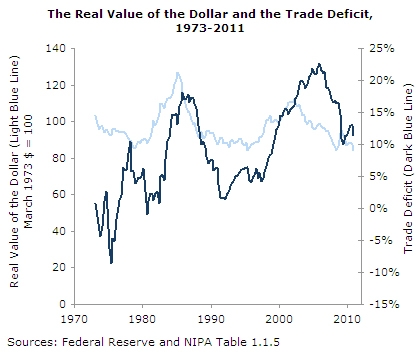
So what's the evidence on this point? Dean Rosnick offers a graph showing two big falls in the value of the dollar after peaks in the mid-80s and mid-2000s, and falls in the trade deficit a few years later, in the early 90s and late 2000s. Early 90s and late 2000s ... hm, what else was happening in those years? Oh, right, deep recessions. (The early 2000s recession was very mild.) Funny that the same guy who's constantly chastising economists for ignoring the growth and collapse of a huge housing bubble, when he turns to trade ... ignores a huge housing bubble.

Still, isn't the picture is basically consistent with the story that when the dollar declines, US imports get more expensive and fall, and US exports get cheaper and rise? Not necessarily: Dean's Rosnick's graph doesn't show imports and exports separately. And when we separate them out, we see something funny.


Click the graph to make it legible.

In a world where trade flows were mainly governed by exchange rates, a country's imports and exports would show a negative correlation. After all, the same exchange-rate change that makes exports more expensive on world markets makes imports cheaper here, and vice versa. But that isn't what we see at all. Except in the 1980s (when the exchange rate clearly did matter, but not in the way Dean Rosnick supposes; see Robert Blecker) exports and imports very clearly move together. And it's not just a matter of a long-term rise in both imports and exports. Every period that saw a significant fall in imports -- 1980-1984; 2000-2002; 2007-2009 -- saw a large fall in exports as well. This is simply not what happens in a world where prices (are the main things that) matter.

(This discrepancy between real-world trade patterns and the textbook vision applies to almost all industrialized countries, and always has. It was noticed long ago by Robert Triffin, who brought it up to argue that movements in relative price levels did not govern trade patterns under the gold standard, as Ricardo and his successors had claimed. But it is just a strong counterargument to today's conventional wisdom that exchange rates govern trade.)

So if changes in exchange rates don't drive trade, what does? Lots of things, many of them no doubt hard to measure, or to influence through policy. But one obvious candidate is changes in incomes. One of the big advances of the first generation of Keynesian economists -- people like Triffin, and especially Joan Robinson -- was to show how, just as prices (the wage and interest rates) fail to equilibrate the domestic economy, leaving aggregate income to adjust, relative prices internationally don't equilibrate the global economy, leaving output or growth rates to adjust. In the short run, business cycle-type fluctuations reliably involve changes in investment and consumer-durable purchases larger disproportionate to the change in output as a whole; given the mix of traded and non-trade goods for most countries, this creates an allometry in which short-run changes in output are accompanied by even larger short-run changes in imports and exports. For a country that runs a trade deficit in "normal" times, this means that recessions are reliably associated with smaller deficits and booms with larger ones. In the long run, there is also a reliable tendency for increments to income to involve demand for a changing mix of goods, with a greater share of demand falling on "leading sectors," historically manufactured goods. (The flipside of this is Engels' law, which states that the share of income spent on food falls as income rises.) Given that both a country's mix of industries and its trade partners are relatively fixed, this creates a stable relationship between relative growth rates and trade balance movements. Neither of these channels is perfectly reliable, by any means -- and the whole point of the industrial policy is to circumvent the second one -- but they are still much stronger influences on trade flows than exchange rates (or other relative prices) are.

So with that in mind, let's look at another version of the graph. This one shows the year-over-year change in the trade balance as a share of GDP, the same change as predicted by an OLS regression on total GDP growth over the past three years, and as predicted by the change in the value of the dollar over the past three years. [1]

It will be legible if you click it.


Not surprisingly, neither prediction gives a terribly close fit. But qualitatively, at least, the predictions based on GDP do a reasonable job: They capture every major worsening and improvement in the trade balance. True, they under-predict the improvement in the trade balance in the later 80s -- the Plaza Accords mattered -- but it's clear that if you knew the rate of GDP growth over the next three years, you could make a reasonably reliable prediction about the the behavior of the trade balance. Knowing the change in the value of the dollar, on the other hand,wouldn't help you much at all. (And just to be clear, this isn't about the particular choice of three years. Two years and four years look roughly similar, and at a one-year horizon exchange rates aren't predictive at all.)

Here's another presentation of the same data, a scatterplot comparing the three-year change in the trade balance to the three-year growth of GDP (blue, left axis) and three-year change in the exchange rate (red, right axis). Again, while the correlation is fairly loose for both, it's clearly tighter for GDP. All the periods of strongest improvement in the trade balance are associated with weak GDP growth, and vice versa; similarly all the periods of strong GDP growth are associated with worsening of the trade balance, and vice versa. There's no such consistent association for the trade balance and changes in the exchange rate.


If you want to be able to read the graph, you should click it.


The fit could be improved by using some measure of disposable income -- ideally adjusted for wealth effects -- in place of GDP, and by using some better measure of relative prices in place of the exchange-rate index -- altho there's some controversy about what that better measure would be. And theoretically, instead of just the three-year change, you should use the individual lags.

Still, the takeaway, if you're a policymaker, is clear. If you want to improve the trade balance, slower growth is the way to go. And if you want to boost growth, you probably are going to have to ignore the trade balance. Personally, I want door number two. I assume Dean Rosnick doesn't want door one. But what I'm not at all sure about, is what concrete evidence makes him think that exchange-rate policy opens up a third door.


[1] Technicalities. I separately regressed the changes in imports and exports (as a percent of GDP) over three years earlier, on the percentage change over the same period in GDP and in the Fed's trade-weighted major-partners dollar index, respectively. It's all quarterly data, downloaded from FRED. The graphs shows the predicted values from the two regressions. This is admittedly crude, but I would argue that the more sophisticated approaches are in some respects less appropriate for the specific question being addressed here. For example, suppose hypothetically that a currency devaluation really did tend to improve the trade balance, but that it also tended to raise GDP growth, raising imports and offsetting the initial improvement. From an analytic standpoint, it might be appropriate to correct for the induced GDP change to get a better estimate of the pure exchange-rate effect. But from a policy perspective, the offsetting growth-imports effect has to be taken into account in evaluating the effects of a devaluation, just as much as the initial trade-balance improvement. Maybe we should say: Academics are interested in partial derivatives, policymakers in total derivatives?


EDIT: Oops! How did I not notice that this article was by somebody named David Rosnick, not Dean Baker? Makes me feel a bit better -- I know Dean does share this article's basic view of trade and the dollar, but I would hope his take would be a little less dependent on textbook syllogisms, and a little more attentive to actual patterns of trade. Clothing from the UK is hardly representative of US imports; to the extent we do import any, it's like to be high-end branded stuff that is particularly price-inelastic.

Tuesday, October 19, 2010

Does the Level of the Dollar Matter?

Mike Konczal has kindly reposted my back-of-the-envelope estimate of how much a dollar devaluation would boost US demand. (Spoiler: Not much.)

I am far from an expert on international trade and exchange rates. (Or on anything else.) Maybe some real economist will see the post and explain why it's all wrong. But until then, I'm going to continue asking why Krugman and others who claim that exchange rates are an important cause of unemployment in this country, never provide any quantitative analysis to back that opinion up.

More abstractly, one might ask: Is the time it takes for demand to respond to changes in relative prices, minus the time it takes for exchange rate changes to move relative prices, greater than the time it takes for exchange rates changes to move relative costs (or to be reversed)? Just because freshwater economists say No for a bad reason (because relative costs adjust instantly) doesn't mean the answer isn't actually No for a good reason.

Tuesday, October 5, 2010

A Bit More on China

Mike Konczal points me to this interesting piece by Walker Frost in The American Scene, on the Chinese currency peg. I asked earlier how much Chinese appreciation would boost US demand (more on that below). But there's a prior question, which is whether an end to Chinese currency intervention would lead to appreciation at all. As Frost points out, the dollar purchases by the central bank coexist with restrictions on private investment abroad and strong incentives for FDI by foreign firms. These policies increase net capital inflows and therefore tend to raise the value of the Chinese currency; the Chinese central bank then pushes it back down with its dollar purchases. It's far from clear which of these effects is stronger, and therefore, whether an across-the-board liberalization would lead the Chinese currency to rise against the dollar, or to fall. In short, we should see Chinese currency interventions not as part of an export-led growth strategy that requires a current-account surplus, but as part of an investment-led growth strategy that would otherwise tend to produce a current-account deficit. [1]

This is a point Anwar Shaikh has also made, when I've discussed this stuff with him. Don't talk about undervaluation, he says, that implies some known free-market equilibrium exchange rate, and there isn't one; talk about stabilization instead.

Another interesting discussion of the Chinese currency peg is in this Deutsche Bank report, which tends to confirm my skepticism about the effect of currency adjustment on US-China trade flows. They note that "RMB appreciation tends to ... reduce nominal wages in the export sector," confirming my sense that exchange rate changes don't reliably move relative costs. And they use an estimate of -0.6 for exchange rate elasticity of Chinese exports. I don't want to put too much weight on this number -- I'm not sure how it's derived -- and they don't give any estiamtes for US-China flows specifically; but given the well-established empirical fact that exchange-rate elasticity is unsually low for US imports, we have to conclude that the number for Chinese exports to the US is substantially lower. So if you believe the Deutsche Bank number for Chinese exports as a whole, my estimate of -0.17 for Chinese exports to the US is probably in the right ballpark. Which, again, means that even a very large Chinese appreciation would have only a trivial impact on US aggregate demand.


[1] The same goes for tariffs and other trade restrictions imposed by Latin American countries as part of import-substitution industrialization.

Saturday, October 2, 2010

... and How About a Higher Yuan?

Another day, another Paul Krugman post blaming China for US unemployment. And maybe he's right. But it would be nice to see some numbers.

On the same lines as my earlier post about the effect of dollar devaluation on aggregate demand, we can make a rough estimate of trade elasticities to calculate the effect of a Chinese revaluation.

Unfortunately, there aren't many recent estimates of bilateral trade elasticities between the US and China. But common sense can get us quite a ways here. In recent years, US imports from China have run around 2 percent of GDP, and US exports to China a bit under 0.5 percent. So even if we assume that (1) a change in the nominal exchange rate is reflected one for one in the real exchange rate, i.e. that it doesn't affect Chinese prices or wages at all; (2) a change in the real exchange rate is passed one for one into prices of Chinese imports in the US; (3) Chinese goods compete only with American-made goods, and not with those of other exporters; and (4) the price elasticity of US imports from China is a very high 4.0; then a 20 percent appreciation of the Chinese currency still boosts US demand by less than 1 percent of GDP.

And of course, those are all wildly optimistic assumptions. My own simple error-correction model, using 1993-2010 data on US imports from China and the relative CPI-deflated bilateral exchange rate, gives an import elasticity of just 0.17. [1] If the real figure is in that range, then a Chinese appreciation of 20 percent will reduce our imports from China by just 0.03 percent of GDP -- and of course much of even that tiny demand shift will be to goods from other low-wage exporters.

I don't claim my estimate is correct. But is it too much to ask that Krugman tell us what estimates he is using, that have convinced him that the best way to help US workers is to foment a trade war with China?


[1] This is a real exchange-rate elasticity, not a price elasticity, so it accounts for incomplete passthrough and offsetting movements in Chinese real wages. It assumes, however, that changes in the nominal exchange rate don't affect inflation in either country; to that extent, it's more likely an overestimate than an underestimate

Thursday, September 30, 2010

How Much Would a Lower Dollar Boost Demand?

Lots of economists of the liberal Keynesian persuasion (Paul Krugman, Dean Baker, Robert Blecker [1] -- very smart guys all) think dollar devaluation is an important step in getting back toward full employment in the US. But have any of them backed this up with a quantitative analysis of how much a lower dollar would raise demand for American goods?

It's not an easy question, of course, but a first cut is not that complicated. There are four variables, two each for imports and exports: How much a given change in the dollar moves prices in the destination country (the passthrough rate), and how much demand for traded goods responds to a change in price (the price elasticity.) [2] We can't observe these relationships directly, of course, so we have to estimate them based on historical data on trade flows and exchange rates. Once we choose values of them, it's straightforward to calculate the effect of a given exchange rate change. And the short answer to this post's title is, Not much.

For passthrough, estimates are quite consistent that dollar changes are passed through more or less one for one to US export prices, but considerably less to US import prices. (In other words, US exporters set prices based solely on domestic costs, but exporters to the US "price to market".) The OECD macro model uses a value of 0.33 for import passthrough at a two-year horizon; a simple OLS regression of changes in import prices on the trade-weighted exchange rate yields basically the same value. Estimates of import price elasticity are almost always less than unity. Here are a few: Kwack et al., 0.93; Crane, Crowley and Quayyum, 0.47 to 0.63; Mann and Plück, 0.28; Marquez, 0.63 to 0.92. [3] (Studies that use the real exchange rate rather than import prices almost all find import elasticities smaller than 0.25, which also supports a passthrough rate of about one-third.) So a reasonable assumption for import price elasticity would be about 0.75; there is no support for a larger value than 1.0. Estimated export elasticities vary more widely, but most fall between 0.5 and 1.0.

So let's use values near the midpoint of the published estimates. Let's say import passthrough of 0.33, import price elasticity of 0.75, and export passthrough and price elasticity both of 1.0. And let's assume initial trade flows at their average levels of the 2000s -- imports of 15 percent of GDP and exports at 10.5 percent of GDP. Given those assumptions, what happens if the dollar falls by 20 percent? The answer is, US net exports increase by 1.9 percent of GDP.

1.9 percent of GDP might sound like a lot (it's about $300 billion). But keep in mind, these are long-run elasticities -- in general, it takes as much as two years for price movements to have their full effect on trade. And the fall in the dollar also can't happen overnight, at least not without severe disruptions to financial markets. So we are talking about an annual boost to demand of somewhere between 0.5 and 1.0 percent of GDP, for two to three years. And then, of course, the stimulus ends, unless the depreciation continues indefinitely. This is less than half the size of the stimulus passed last January (altho to be fair, increased demand for tradables will certainly have a higher multiplier than the tax cuts that made up a large share of the Obama stimulus.) The employment effect woul probably be of the same magnitude -- a reduction of the unemployment rate by between 0.5 and 1.0 points.

I would argue this is still an overestimate, since it ignores income effects, which are much stronger determinants of trade than exchange rates are -- to the extent the US grows faster and its trading partners grow more slowly as a stronger US current account, that will tend to cancel out the initial improvement. I would also argue that the gain to US employment from this sort of rebalancing would be more than offset by the loss to our trade partners, who are much more likely to face balance of payments constraints on domestic demand.

But those are second-order issues. The real question is, why aren't the economist calling for a lower dollar providing quantitative estimates of its effects, and explicitly stating their assumptions? Because on its face, the data suggests that an overvalued dollar plays only a modest role in US unemployment.


[1] I was going to include Peter Dorman on this list but I see that while he shares the IMO misplaced concern with global imbalances, he says, "Will a coordinated dollar devaluation do the trick? Maybe, if you can get coordination (no easy feat), but it is also possible that US capacity in tradables has deteriorated too far for price adjustment alone to succeed." Which is a more realistic view of the matter than the one Krugman seems to hold. On the other hand, Dorman was also writing just a couple years ago about The Coming Dollar Crash. That dog that didn't bark is something I'll hopefully be writing about in a future post.

[2] Many studies collapse passthrough and price elasticity into a single measure of real exchange rate elasticity. While this is a standard approach -- about half the published papers take it -- I would argue it's not the right one for either analytic or policy purposes. Analytically, the real exchange rate elasticity doesn't distinguish between the behavior of buyers and sellers: A low value could mean either that consumers are not responsive to price, or that sellers are holding price stable in the face of exchange rate changes. And on the other side, it's the nominal, not real, exchange rate that's accessible to policy. Policy-induced movements in the nominal exchange rate only translate into movements in the real rate if we assume that price levels (and real wages, if we're deflating by labor costs) don't respond to movements in the exchange rate, which is not generally a safe assumption.

[3] Price elasticities are all negative of course. I'm omitting the negative sign for simplicity.